
Being 35
Halfway through my three-score-years-and-ten

Note: This whole essay has an overriding paradigm of good physical health, of “being dealt a good hand” in that way. To expand out from that paradigm would be the task of another essay but I wanted to acknowledge it here because that’s far from everyone’s experience. It has been mine and I know that I am enormously fortunate in that way.
A few years ago, I was a quasi-faculty member at a camp put on by my college friend’s family - mostly his mom. At one point, she and I and some of the campers, who were all youngins, 8-16 or so, sat in a circle to do a rhythm activity of some kind. To introduce ourselves, my friend’s mom directed the campers to say their name, their age, and their favorite ice cream color. Since she was (forgive me) a bit older, I was surprised at this selection, and wondered what she would say. I’ll never forget her answer: “My age is ‘adult.’”
Duh! I was so struck. Of course that’s the correct answer. Ages stop being interesting once you’re an adult because you become the same age as all the other adults.
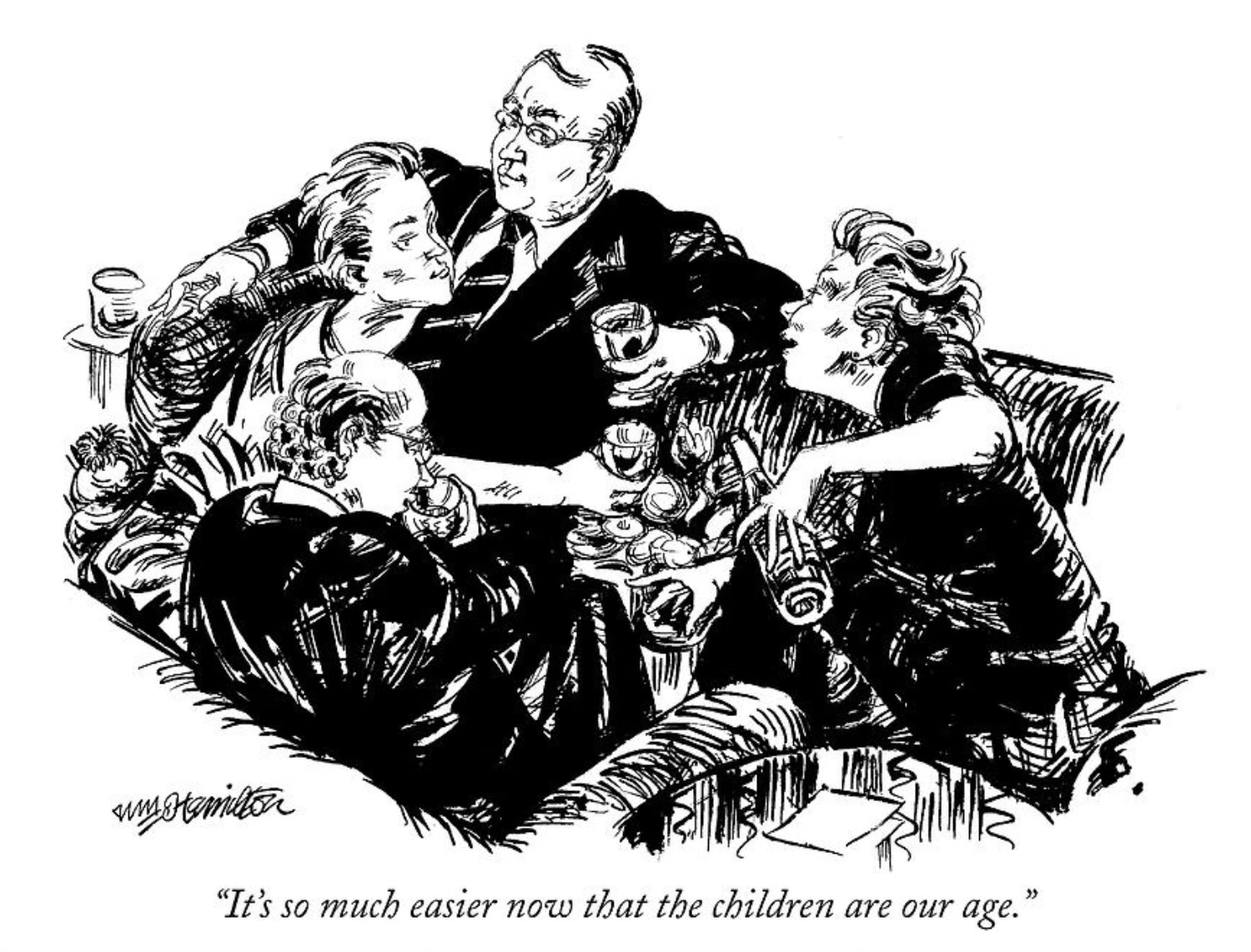
I think it’s always been my destiny to be an adult. I’ve felt like one for several years now. Even when I’ve not felt fully confident in my adult choices, I don’t have that feeling of still being a kid like I’ve heard other adults report. Instead, I have felt like an adult with questions. Most adults have questions. In the past, more of these questions had answers provided by systems, so more adults were able to prop up their uncertainty in systems more easily. It wasn’t better.
This is the year I’ve successfully been able to tune out a lot of noise. Noise about being unmarried and childless at a certain age (the fact that I’m writing about it is an indication that it doesn’t stress me out so much that I dissociate); noise about maybe-I-should-go-get-a-degree, noise about certain worries I should have because of how long ago I was born.
I have felt a vivid sensation several times this year. I’ve felt it before, but it has come up a lot lately. That sensation is: if I had a child, this thing that feels small to me would be huge to it.
Like…
• …the $20 sandals with pastel woven straps that I wore to death last year, until the bottoms were dark and hollowed with the shapes and grime of my feet and the straps had been stretched and distended. I got them because I needed sandals and I liked them. If I had sat cross-legged next to my child those shoes would have been big. In therapy years later they’d go spelunking for memories of me and those shoes would loom up with my unshaved legs.
• … my keychain which has accrued all these random keys. It’s heavy. It’s the keyring of an adult. My child would not think, “My mom has a heavy keychain,” but they would notice its heaviness and watch its movements from purse to doorknob, from hand to table, see it splayed out like a fish, wonder about all the things it unlocked, wonder about the world with all those locks in it.
• … the album I fixated on for a couple of weeks would become eternal to a child. They’d compare everything to it. They’d play it for their children, inspired by a feeling of nostalgia and the idea that this album would connect them to that thread of eternity. Or not, if they didn’t like it. And however the car smelled that year, that’s how the album would smell to them. This album will always make me think of my mother.
• … or, omg, what about the week I would put on Schubert and do some light yoga before bed? It would have been so fascinating to see one’s mother do yoga. This is the first year I’m truly putting on Schubert songs for fun and not some weird obligation to the person I was before college traumatized me.)
To me these things are not particularly interesting or important. They are choices I make because I am trying to catch life as it comes and get through it. They happen incidentally. To have these choices witnessed with the depth of the attention of a child in the process of orientation to the world is - well, it’s something I’m not experiencing, and I guess I thought I would be.
It’s a lot of pressure, for sure, to have young beings absorbing you so closely. So many things can go “wrong.” What if the album is bad and you give your child bad taste? What if they see you losing your big keychain and throwing a fit all the time, and the fit you throw fills their formative memories with scary thunderclouds of emotion that make them want to hide whenever it’s time to leave the house? What if they are sitting beside you and your toenails are gross because you don’t think about them the correct amount and they get traumatized by your feet? Or even worse things.
It could be that I’m noticing these things now more than before because I finally have a level of self-confidence that I would be okay with the way I unconsciously radiate being absorbed by young children. It doesn’t seem scary to me anymore.
It isn’t a particularly sad feeling, though it has a couple melancholy overtones. There’s never been a time in my life where it seemed like children would fit into it any time soon, but, I did always expect to have them by now. I have something else instead, something precious that no money can buy: no pain-in-the-ass husband to pick up after and snore up my bed while I stare out the window and slide between dissociation and pondering whether I regret everything, no human beings to assume complete responsibility of and forgo my own direction for entirely, a quiet home in which I can be myself and figure out my business. As a single, childless woman of 35, with the world’s greatest dog to hang out with every day, I am immensely fortunate and free. And, yeah! A little lonely.
In lieu of kids thinking the minutia of my life are disproportionately fascinating, I suppose it’s up to me to expand my sense of presence and attention to the things that I direct to take up space and time in my life, so that it doesn’t go by with no one having beheld it. I do have some since of pervasive animism and a sense that human attention is very powerful, so it should be possible to transform the loneliness into a sense of convivial belonging if I am immersed in my life as it is, and not distracted by yearning for something that isn’t there.
There’s a guy whose instagram videos I’m getting - I’ve gotten two - he stands in front of a sunset, or in front of two lizards, and says, “describe this without using words.” And he sits there and stays quiet while you do that. It’s amazingly effective, you really do disappear into the thing like you did when you were a child. Your attention expands so much. It is an authentic way to look at things, too, because the matrix we develop as adults is ultimately artificial and can be lifted. That’s what psychedelics do. But you can get psychedelics-at-home by just pretending you don’t have words for stuff. (And you can get cannabis-at-home by taking a brisk walk once a day! The runner’s high is an endocannabinoid thing.) The tricky part is finding the space in the hours of the day to do it, which is not so straightforward when you experience them as beating relentlessly on the shore of your life, to navigate them like a ship, cutting through them and managing to stay afloat. But what else are you gonna do? Pass away? Come on.
—
One moment of my childhood that loomed disproportionately large is a memory of my grandmother, sharing a poem about cherry blossoms with us. Grandparents are more aware of how these moments work, and my grandmother was deeply attuned to freshness and beauty, which meant she was intentional about flowers. One of my two earliest memories is of being wheeled through a rose garden with this grandmother, my very young self taking in washes of color and form for which I had no words.
She and my grandfather took the three girls on three trips on the train to Washington, DC, where we saw the Washington Mall decked out in its cherry blossoms. In the spirit of cherry blossoms being important to her, she was reciting this poem. She may have only done it once, but I have the sensation of her reciting it many times over the course of weeks — it feels like a whole phase of her life. In the specific memory I have, she was walking us granddaughters through the poem, inviting us to ponder what the individual lines actually meant.
Loveliest of trees, the cherry now
Is hung with bloom along the bough,
And stands about the woodland ride
Wearing white for Eastertide.

Now, of my threescore years and ten,
Twenty will not come again,
And take from seventy springs a score,
It only leaves me fifty more.

And since to look at things in bloom
Fifty springs are little room,
About the woodlands I will go
To see the cherry hung with snow.
I specifically remember the mathematical riddle. “‘Now, of my threescore years and ten,’” she said in a gently singsongy way, “‘twenty will not come again.’ How old is the speaker?”
I had no idea. I didn’t know what a score was.
“A score is twenty.”
Okay. I still couldn’t get it.
She spelled out that the poem suggested that the writer has been allotted three-times-twenty years and ten more years. So, seventy years in total.
I still couldn’t get it. I guessed he was fifty???
“No,” she explained, “he’s twenty. Twenty will not come again. That means he’s spent them.”
Oh. I felt a little annoyed because it turned out not to be a math question at all, the answer was just right there.
She continued, “‘And take from seventy springs a score, that only leaves me fifty more.’ So he has fifty years remaining of his seventy.”
Okay. Fine.
Then she finished the poem, animated, sure, engaged in her full Aries brightness. “Fifty years leaves little room…”
Little room, huh? Fifty years is little room?
Listen: the memory is lovely, and I wouldn’t swap it for anything. I didn’t realize it at the time, but it laid an intractable foundation for my ability to sit with poetry. But, BUT, you can bet it set a clock ticking in me. “Three-score-years-and-ten”…
The idea of sharing the poem with the grandchildren was to tune them in to cherry blossoms. But what happened was that I got plugged into anxiety that I wasn’t seeing enough cherry blossoms because fifty years wasn’t enough to see enough and I wasn’t even seeing them every year.
On my twentieth birthday, I had breakfast with my parents who came up to visit me in Nashville, and an online friend swinging into town, but who they didn’t see at that table were two ghosts who had been hovering there for me, waiting this whole time: the lines “twenty will not come again” and “fifty years leaves little room.”
And when my grandmother died at age 81, it was much sooner than I wanted, and much sooner than her mother and all her aunts had died — but, I did think, “she outlived her three-score-and-ten by eleven.”
And guess what happens at thirty-five? Tick tick tick … tilt.
Except, what it tilted into was not a sense that I’d lived half my life at all. It actually tilted me off the scale of quantizing my life into imagined fractions. I was finally free.
—
Later, in English class, I learned about this poet. A. E. Housman. A Victorian. And what I learned about the Victorians was that they were sad, sad, sad, sad, sad! Our teacher was very comfortable telling us this. And I am glad because that contextualizes the fucking cherry tree poem! It is a profoundly melancholy poem in disguise.
But I get it! The sadness is there. It’s in every step taken by mortal man. Every perception of beauty includes the perception of its impermanence. To leave it out the melancholy is to distort the scale of any experience. It’s not my preferred orientation towards the world, but I get it, and I love the sad Victorian poems.
However, I must say … turning 35 and being finally able to shake off the Housman curse has given me perspective that this anxiety about aging is a young person’s thing.
Here’s another Housman poem.
When I was one-and-twenty
I heard a wise man say,
“Give crowns and pounds and guineas
But not your heart away;
Give pearls away and rubies
But keep your fancy free.”
But I was one-and-twenty,
No use to talk to me.
When I was one-and-twenty
I heard him say again,
“The heart out of the bosom
Was never given in vain;
’Tis paid with sighs a plenty
And sold for endless rue.”
And I am two-and-twenty,
And oh, ’tis true, ’tis true.
How old was that wise man, do you think? Two-and-twenty? Three-and-twenty at the time of this writing?
If he was two-and-twenty he might have been T. S. Eliot, not a Victorian but author of “The Love Song of J. Alfred Prufrock,” probably the most well-known poem we have about the anxiety of aging. He started writing it at this twenty-two age, Twenty-two was publishing it at age twenty-seven, which makes it a Saturn return poem for him, which means he was just embarking on astrological young adulthood. You know the poem. Here’s a bit from it. The whole thing is quotable for this theme.
“I grow old, I grow old,
I shall wear the bottoms of my trousers rolled…
Shall I part my hair behind? Do I dare to eat a peach?
I shall wear white flannel trousers and walk along the beach.
I have heard the mermaids singing, each to each.
I do not think that they will sing to me.”
I do do do love this poem. But reading it now, it does not feel like my poem anymore. It feels like a young man’s poem! All this anxiety about aging seems like the anxiety of a young person. A regular person (age 35 or UP) just parts their hair where they want it, eats the peach they want, wears comfortable trousers that pleases him, walks along the beach. Hears the mermaids singing? Sure. But not any one of us are mermen. Once you’re not young anymore, it’s not so uncomfortable not to be a merman. You’ve got the legs you’ve got. In whose life are you Hamlet or an attendant lord? What scenes are you starting or not? Regular people aren’t worried about the sphere of their influence. They aren’t worried about conversations they overhear that have nothing to do with them. They know that the specter of their greatness was always a specter, and all it ever did was haunt them. In the light of being adult-age, it vanishes like a Scooby-Doo villain.
We don’t really “age,” do we? That’s a young person’s verb. When we are children, we grow. Then when we are young, we retain some of the magical regenerative supportive qualities leftover from childhood, in which it is hoped you can establish a workable foundation for health. And after that, we just live, until we can’t maintain those systems anymore, which isn’t a linear thing at all. Then after all that, we decay towards death and let things go. Then we die.
It’s been understood as a linear process, because all of the studies have been done on members of very sick civilizations. Obviously we’re not exactly a “well civilization” now, but we know more about how health works than ever before, and have access to more resources than ever before.
—
Several months ago, a friend of mine told me about the first joke he made spontaneously in his second language. It… ooh I don’t have it exactly. It had something to do with how every meal you ate was one less meal left between you and death. (Should be one fewer but English is tough.) So when he and his college roommate would get a meal they would joke about how it was one less meal.
It was funny. However, I was unfortunately unable to participate fully in the spirit of the anecdote in which it was told to me, as a second-language triumph, because an aspect of the underlying ethos seized me suddenly and I had to go off about it. “It’s actually one more meal,” I said, with neurodivergent loudness, “because if you didn’t eat it, you would starve.”
My friend was a bit surprised and tried to coax me back to the spirit of the anecdote.
“Every meal you eat extends your lifespan,” I blustered on over-literally. “The food you eat becomes your body. Eating restores your ability to continue having a body.”
Another thing about being adult is that I can very often detect in advance when my over-literalness is going to be socially inappropriate, and choose to lean into it or not. In this case, I chose to go into it, because I felt something shifting for me, about the way we measure our life or not. No, our time is not fixed. No, you cannot count your meals backwards. No, you cannot dole out life out in coffee spoons. No, life is not a fixed track barreling towards the looming reaper. We choose to extend or not to extend in every moment based on whether we take another breath or not. Whether we eat another meal or not. Life grows upwards and outwards like a tree…
To be halfway through your life at thirty-five is not inevitable. It simply means you didn’t need to do anything to be healthy in your youth, and you aren’t about to start doing anything to be healthy now. I don’t feel like that. I feel like youth is supportive in the way college is supportive: you have the comfortable dormitories of your body, the meal plans of your metabolism, the small walkable environment and beautiful campus of your super-long-telomeres and self-regenerating capacities, so that you can develop a sense of what you are good at, what you like, what it feels like to have agency and be part of a community. To me, turning thirty-five feels like shaking hands with Father Time the president of the university while he hands me a diploma. Like the beginning of actual personhood.